


From Factory Floor to Field Service: The New Operating Model for Asset-Driven Businesses
(Why Lifecycle Thinking Is Replacing Functional Silos in Manufacturing and Asset Services)
For decades, asset-driven businesses were organised around a simple boundary:
Manufacturing builds the asset.
Service maintains it.
What happens in between, and after, was treated as someone else’s problem.
That operating model no longer works.
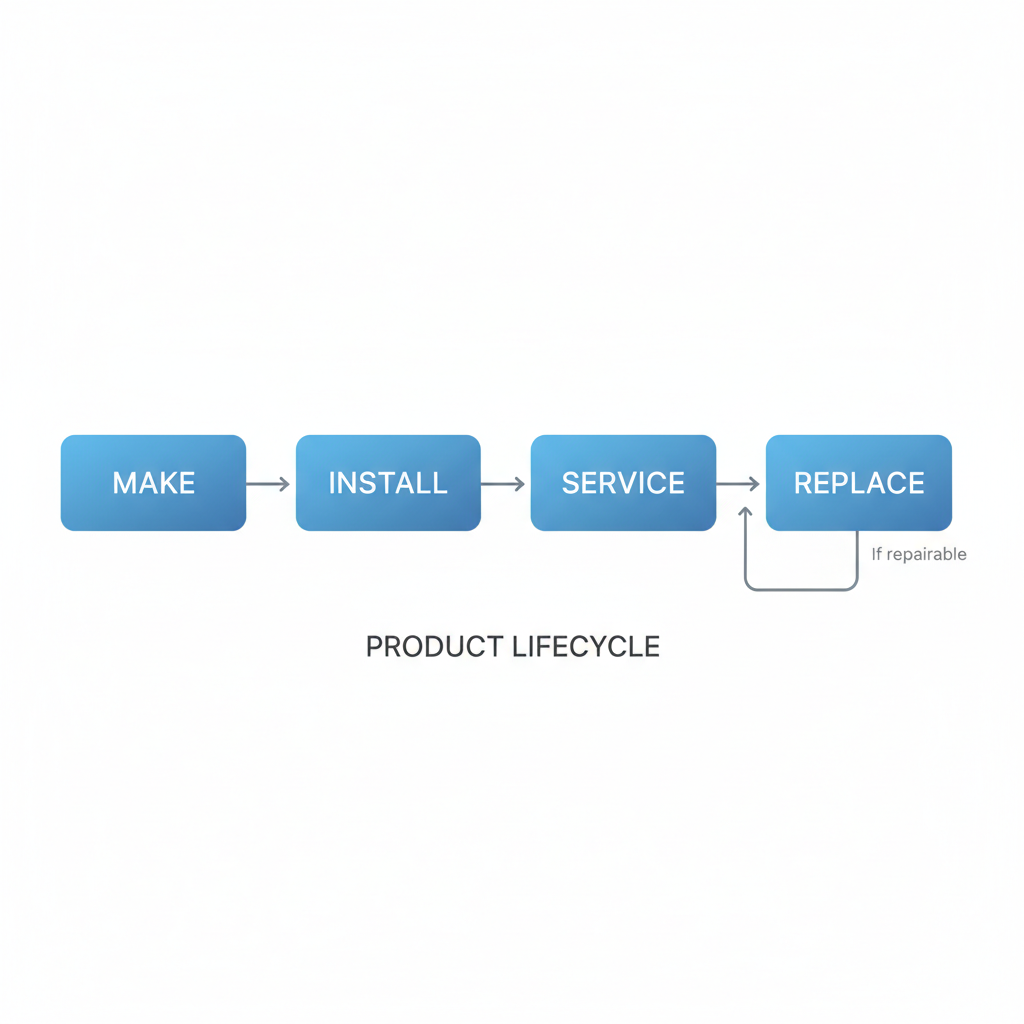
In Manufacturing and Asset Services, value is no longer created at the moment an asset leaves the factory. It is created, or destroyed, across the full lifecycle:
Make → Install → Service → Replace
This article explores why asset-driven businesses are shifting to lifecycle-centric operating models, how disconnected systems cause revenue leakage and blind spots, and why a unified data model is foundational for predictive, service-led growth.
The Old Model: Build It, Ship It, Forget It
The New Reality: Assets Are Long-Lived Value Engines
Modern asset-driven businesses depend on:
- Installed base revenue
- Service contracts
- Consumables
- Upgrades
- Performance-based agreements
In many industries, lifetime service revenue exceeds the original asset sale.
Yet most systems still treat service as an afterthought.
This mismatch is why operating models are changing.

The New Reality: Assets Are Long-Lived Value Engines
Modern asset-driven businesses depend on:
- Installed base revenue
- Service contracts
- Consumables
- Upgrades
- Performance-based agreements
In many industries, lifetime service revenue exceeds the original asset sale.
Yet most systems still treat service as an afterthought.
This mismatch is why operating models are changing.
Make → Install → Service → Replace: One Lifecycle, Not Four Handoffs
Let’s look at the lifecycle honestly.
1. Make (Manufacturing)
Manufacturing knows:
- BOMs
- Serial numbers
- Configuration
- Quality history
But this data often stops at shipment.
2. Install (Deployment)
Installation adds:
- Location
- Environment
- Usage context
- Customer configuration
This information is rarely fed back into manufacturing insight.
3. Service (Operations)
Service generates:
- Work orders
- Failure patterns
- Parts consumption
- Technician actions
But this intelligence often lives outside ERP.
4. Replace (End of Life)
Replacement decisions depend on:
- Maintenance history
- Downtime cost
- Remaining useful life
- Financial performance
Without lifecycle data, replacement is guesswork.
When these stages are disconnected, the asset’s story is broken.
The Unified Data Model: Where Lifecycle Thinking Becomes Real
Lifecycle thinking is not a mindset problem.
It is a data problem.
A unified data model means:
- One asset record
- Persistent from manufacture to retirement
- Enriched at every stage
This allows:
- Manufacturing to see how assets perform in the field
- Service to see how assets were built
- Finance to see true lifecycle cost
- Leadership to see real asset profitability
Without a unified model, lifecycle insight is reconstructed, late and imperfectly.
Revenue Leakage in Service Contracts: The Silent Killer
Service revenue looks healthy on paper.
In reality, many organisations leak value through:
- Missed billable work
- Untracked contract entitlements
- Incorrect parts usage
- Unclaimed warranty costs
Why?
Because service contracts, assets, and financials live in different systems.
Common symptoms:
- Technicians perform work not covered by contract, unpaid
- Customers receive services beyond entitlement, unnoticed
- Parts consumed without financial reconciliation
- SLAs breached without visibility
This is not a service execution problem.
It is a data continuity problem.
When Service Is Blind, Margins Erode Quietly
Service teams often lack:
- Real-time asset configuration
- Contract coverage visibility
- Historical failure context
So they default to:
- Over-servicing
- Over-stocking
- Over-escalation
Each action feels safe.
Collectively, they erode margin.
Lifecycle visibility turns service from a cost centre into a controlled revenue engine.
Predictive Maintenance: Readiness vs Reality
Everyone talks about predictive maintenance.
Few are ready for it.
Predictive maintenance does not start with algorithms.
It starts with:
- Clean asset history
- Accurate service data
- Consistent usage tracking
- Integrated financial context
If service data is fragmented:
- Predictions are noisy
- Alerts are ignored
- Trust erodes
Predictive maintenance is not an add-on.
It is the outcome of a connected lifecycle operating model.
Why Functional Silos Block Lifecycle Intelligence
Silos exist because systems enforce them.
Manufacturing ERP
Service Management
Asset Registers
Finance Systems
Each answers a different question.
None answers:
“What is the full economic and operational story of this asset?”
Lifecycle thinking requires:
- Shared identifiers
- Shared timelines
- Shared truth
Without that, organisations debate whose data is “right” instead of acting.
Why Platform Matters for Lifecycle Operating Models
Lifecycle models collapse when:
- Data must be synced
- Interfaces lag
- Ownership is unclear
A platform with:
- One security model
- One data foundation
- One audit trail
…allows lifecycle insight to be native, not engineered.
This is where Salesforce-native architectures change what’s possible.
Salesforce-Native ERP and Asset Lifecycle Continuity
When manufacturing, service, and finance run natively on Salesforce:
- Asset identity persists across systems
- Service events update financial context in real time
- Manufacturing learns from field performance
- Replacement decisions are evidence-based
The asset stops being “handed off”.
It becomes continuously understood.

The New Operating Model in Practice
Asset-driven leaders are reorganising around:
- Installed base visibility
- Service profitability
- Lifecycle margin, not transaction margin
This requires:
- One version of asset truth
- One operating model across functions
- Systems that expect long-lived relationships
Manufacturing and service are no longer separate businesses.
They are two phases of the same value stream.
Assets Don’t End at Shipment
The biggest shift in asset-driven businesses is philosophical:
The factory floor is not the finish line.
Value is realised:
- In the field
- Over time
- Through insight
Businesses that adopt lifecycle operating models don’t just service assets better.
They understand them better.
And understanding compounds.
