
Skip links
SERVICE APPOINTMENT SCHEDULING

Schedule the right service. Send the right team.

Connect service requests, appointments, technician availability, work orders and inventory in one Salesforce workflow, so every job has a clear next step from booking to completion.

EXPLORE THE FLOW Built for connected service operations
LIVE SERVICE APPOINTMENTCONFIRMED
CustomerNorthstar ManufacturingPriority service · On-site appointment
01RequestCaptured
02Technician matchQualified
03AppointmentConfirmed
04CompletionNext
ASSIGNED TECHJordan LeeQualified · Available
APPOINTMENTTomorrow, 10:3090-minute service window
Every team sees the same next step.
SERVICE OPERATIONS

When service scheduling turns into manual coordination

A customer needs service, but scheduling the right appointment can quickly become a chain of calls, calendar checks and manual handoffs when the workflow is disconnected.

Then the customer calls back. No update.

Sales reaches out to service. Still waiting.

The customer calls again. So sales tracks someone down, gets an answer, calls the customer back and follows up the next day to make sure the issue actually got handled.

Eventually, the problem is resolved. Until the next service issue. Then it happens again.

“It becomes easier to manage the issue yourself than it is to manage the handoff.”

So the salesperson calls the technician directly, chases the part, coordinates schedules, messages service and updates the customer. A workaround has appeared, not because anyone wanted more work, but because it became the most reliable way to take care of the customer.

Then something dangerous happens: the workaround starts working well enough that everyone forgets why it existed.
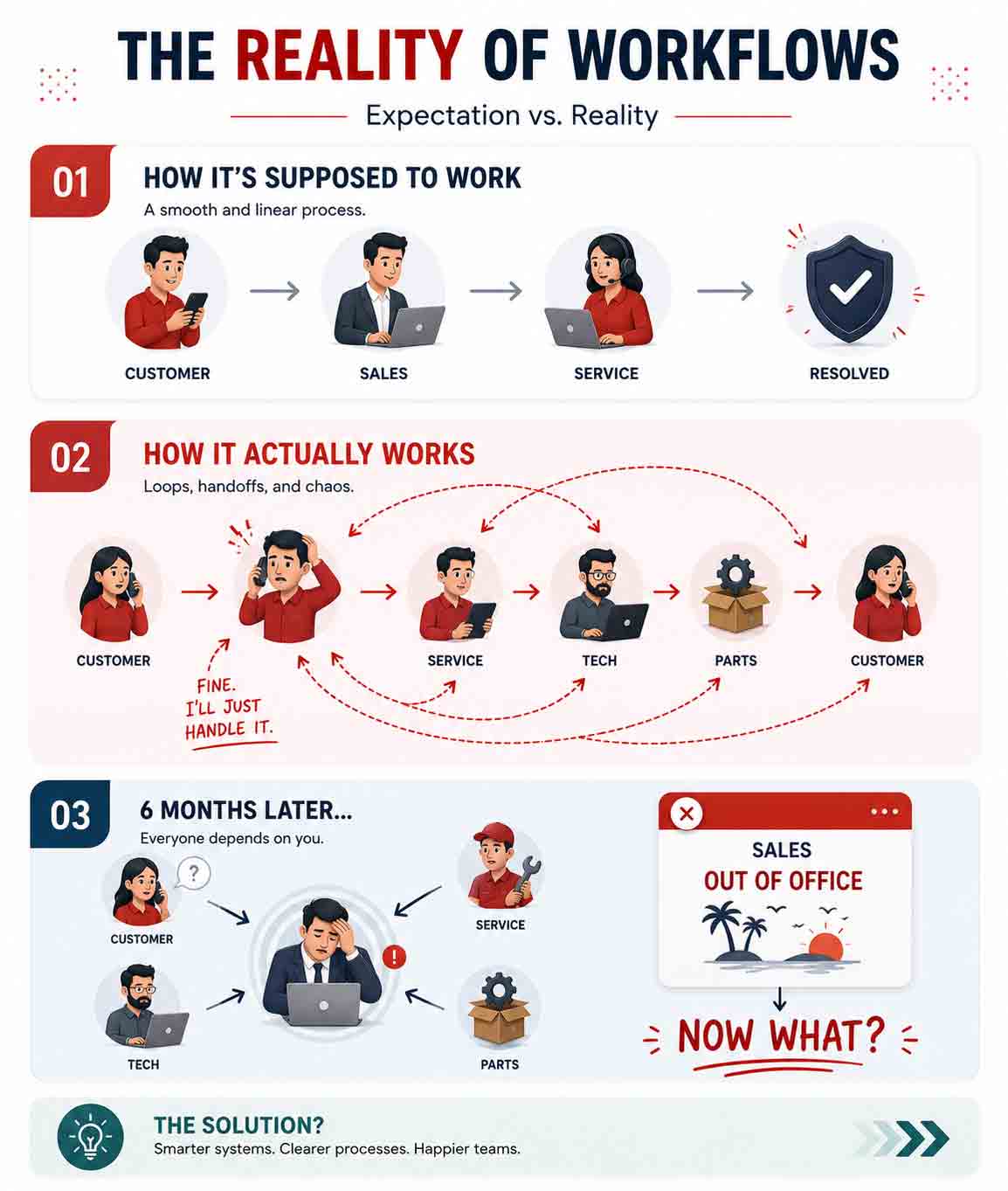
Illustrated service workflow showing the ideal process, manual workaround and dependency risk.
When the workflow is disconnected, people become the process.
THE WORKAROUND PROBLEM

When a Person Becomes the Process

●   EXPECTED

A clear service appointment flow

Request captured. Right resource matched. Appointment confirmed.

CustomerRequests service
ScheduleFinds the right slot
TechnicianAssigned and prepared
CompletedWork closed
●   REALITY

Manual coordination becomes the workflow

Availability, technician details, parts and customer updates are chased across teams.

CustomerNeeds an update
DispatcherManual coordinator!
Service
×Tech
Parts
CustomerStill waiting
THE HIDDEN WORKAROUND“I’ll check everyone manually.”
●   LATER ON

The workaround becomes the system

One person steps away, and every hidden dependency becomes visible.

THE BREAKING POINTWho can see and own the next step?
CUST.SERVICETECHPARTSUNAVAILABLECOORDINATOR
CONNECTED OPERATIONSONE SHARED SYSTEM OF RECORD
01WITH A CONNECTED WORKFLOW
CustomerService requested
Service hubOwnership assigned
Field teamWork scheduled
CompletedCustomer updated
02WHEN THE WORKFLOW LIVES IN PEOPLEHidden handoffs
CustomerNeeds an update
ServiceWaiting on parts
Field techNeeds access
PartsNeeds confirmation
SALESPerson as
the process
Chasing every handoff
!

Without a shared operational workflow, the fastest route through the work becomes one person’s memory, relationships and follow-up.

03WHEN THAT PERSON IS UNAVAILABLE
CustomerServiceField teamParts
SALESOUT OF OFFICE

The work is still there.
But its route has disappeared.

01 HOW IT'S SUPPOSED TO WORK
Customer
Sales
Service
Resolved
02 HOW IT ACTUALLY WORKS
Customer
!Sales“Fine. I'll handle it.”
Service
Tech
Parts
Customer
Sales chases updates, schedules, technicians and parts because the handoff has no shared operational workflow.
03 6 MONTHS LATER...
CustomerServiceTechParts
SALES
OUT OF OFFICE
NOW WHAT?

The person compensating for the process disappears, and suddenly the process gap becomes impossible to ignore.

The workaround becomes the process.

Customers learn to call sales because they get results. Service learns that sales will step in when something gets stuck. Leadership sees customers being taken care of.

And the person holding it together becomes indispensable. Until they leave.

The real problem is not the calendar. It is the disconnected workflow.

Most companies think scheduling problems look like this:

  • Too many appointments
  • Double bookings
  • Technician availability
  • Missed appointments
  • Poor route planning
THE DEEPER PROBLEM

The absence of a shared operational workflow.

When a customer reports an issue, everyone should be able to answer the same questions from the same process.

01 What happened?
02 Who owns it?
03 What happens next?
04 Which technician is assigned?
05 Do we have the required part?
06 Has the appointment been confirmed?

If those answers live across Salesforce, email, spreadsheets, phone calls, technician notebooks and someone's memory, the business doesn't have a service process. It has a collection of people compensating for one.

The Hidden Cost of the Workaround

01

Sales becomes a dispatcher

Account managers chase technicians and service coordinators instead of selling.

02

Service becomes reactive

Teams respond to whoever is shouting loudest rather than a controlled queue of work.

03

Technicians lose productive time

Time disappears into status questions, information hunting and coordination.

04

Customers lose confidence

Customers do not care which department owns the problem. They care whether someone owns it.

05

Management loses visibility

Individual problems are resolved, while the operational friction remains hidden.

A service appointment should move through one connected workflow.

A modern service process should begin the moment the service requirement is identified, then move through one connected workflow.

01!IssueRequirement identified
02Service RequestContext captured
03Work OrderAction defined
04Parts CheckAvailability verified
05TechnicianSkills and location
06AppointmentCustomer confirmed
07Field ExecutionWork performed
08ResolutionOutcome recorded
CONNECTED CONTEXT Customer · Asset · Service history · Parts · Inventory · Technician · Finance

The Appointment Is Only One Part of the Process

Scheduling software can tell you that a technician is available. The more important question is whether that technician can actually complete the job. That is where field service scheduling benefits from live operational context, including inventory availability and resource readiness.

Right skillsRight territoryRequired partsAsset history Warranty statusService contractCustomer accessNearby workload
Scheduling without operational context is just calendar management.

Connected Service Execution Inside Salesforce

For companies already running Salesforce, the customer relationship and much of the surrounding context may already exist. The challenge is connecting that context to operational execution.

Axolt can connect customer, asset, service request, work order, appointment, technician, parts, inventory, service completion and finance inside the Salesforce environment.

CustomerAssetService RequestWork OrderAppointmentTechnician + PartsService Completion + Finance

Your Best Salesperson Shouldn't Be the Integration Between CRM and Service.

If a salesperson has to remember who to call, which technician handles which equipment, whether a part arrived, when the appointment was scheduled and whether the customer was updated, the company has effectively turned an employee into middleware.

EMPLOYEE-BASED MIDDLEWARE
  • Doesn't scale
  • Doesn't document itself
  • Doesn't provide reliable reporting
  • Eventually, someone leaves
AXOLT ON SALESFORCE

Turn service handoffs into a connected workflow.

Bring requests, appointments, technicians, parts and customer updates together in Salesforce.

SCHEDULE A DEMO See Axolt in action with your service process.