

Why Standard Costs Need an Annual Update
Standard costing values every receipt, issue, completion, and shipment at a predetermined cost. That works well while the standards reflect reality. A year later, purchase prices, labor rates, yields, and overhead budgets have all moved, and the gap shows up as variances on every work order.
- Variances stop meaning anything. If every work order shows a 6% unfavorable material variance because steel prices rose in March, the variance report no longer tells you anything about how production performed.
- Inventory drifts from actual cost. IAS 2 allows standard costs for convenience only if the results approximate cost, and expects standards to be reviewed regularly. ASC 330 accepts standard costs that are adjusted at reasonable intervals to reflect current conditions.
- Pricing and margin decisions depend on them. Quotes, product margins, and make-or-buy decisions usually start from standard cost. Out-of-date standards lead to wrong decisions, not just wrong reports.
Most manufacturers update all standards once a year, effective on the first day of the new fiscal year, and make event-driven updates in between when a major input changes. Our guide to manufacturing cost variance analysis explains how variances are measured and reviewed during the year. This article covers the annual reset.
What Goes into a Standard Cost
A standard cost per unit is built from the same elements that production will be measured against:
- Material: the standard quantity per unit from the bill of materials, including expected scrap and yield, multiplied by the standard purchase price. If you capitalize freight and duty, include them; our guide to landed cost explains how.
- Labor: standard hours per unit from the routing, multiplied by the standard labor rate, including payroll costs and benefits.
- Overhead: standard machine or labor hours multiplied by the overhead rate, which is the budgeted production overhead divided by normal capacity.
- Outside processing: subcontracted operations, such as coating or heat treatment, at the expected supplier price.
The overhead rate needs particular care. Both IAS 2 and ASC 330 require fixed production overhead to be allocated based on normal capacity, so a year of unusually low production does not inflate the cost of every unit. Just as important is the basis for each input:
Use as a Basis
- Contracted prices for the coming year
- Current supplier quotes
- Expected average price based on the purchasing forecast
- Labor rates from the approved budget
- Yields and run times proven over several months
- Overhead budget divided by normal capacity
Avoid as a Basis
- The last invoice price
- One-off spot buys or rush orders
- Prices from a supplier you are replacing
- Best-ever run times from a single good week
- Production volumes the plant has never reached
- Engineering changes that have not been released
Plan the Update Before Year End
A standard cost update touches purchasing, engineering, production, and finance. Treat it as a project with an owner, a calendar, and an approval step, and work through it in this order:
- Set the effective date and ownersNew standards usually take effect on the first day of the fiscal year. Agree who supplies each input and who approves the result.
- Freeze the BOM and routing basisDecide which bill of materials and routing versions the new standards will use, and whether engineering changes due early next year are in or out.
- Update purchase pricesUse contracted prices, current quotes, or the expected average price for the coming year, and record the basis for each item.
- Update labor and overhead ratesTake wage rates and the overhead budget from next year's approved budget, and divide overhead by normal capacity, not by a stretch target.
- Review yields and run timesCompare last year's actual scrap and run times with the current standards, and change them only where the improvement or deterioration is expected to last.
- Roll up and compareCalculate the new standards through every BOM level, and compare each item with its current standard by cost element.
- Approve and freezeFinance and operations review the largest changes and sign off. Freeze the pending standards so they cannot change before the effective date.
- Activate and revalueOn the effective date, activate the new standards and revalue the inventory on hand.
How the Cost Roll-Up Works
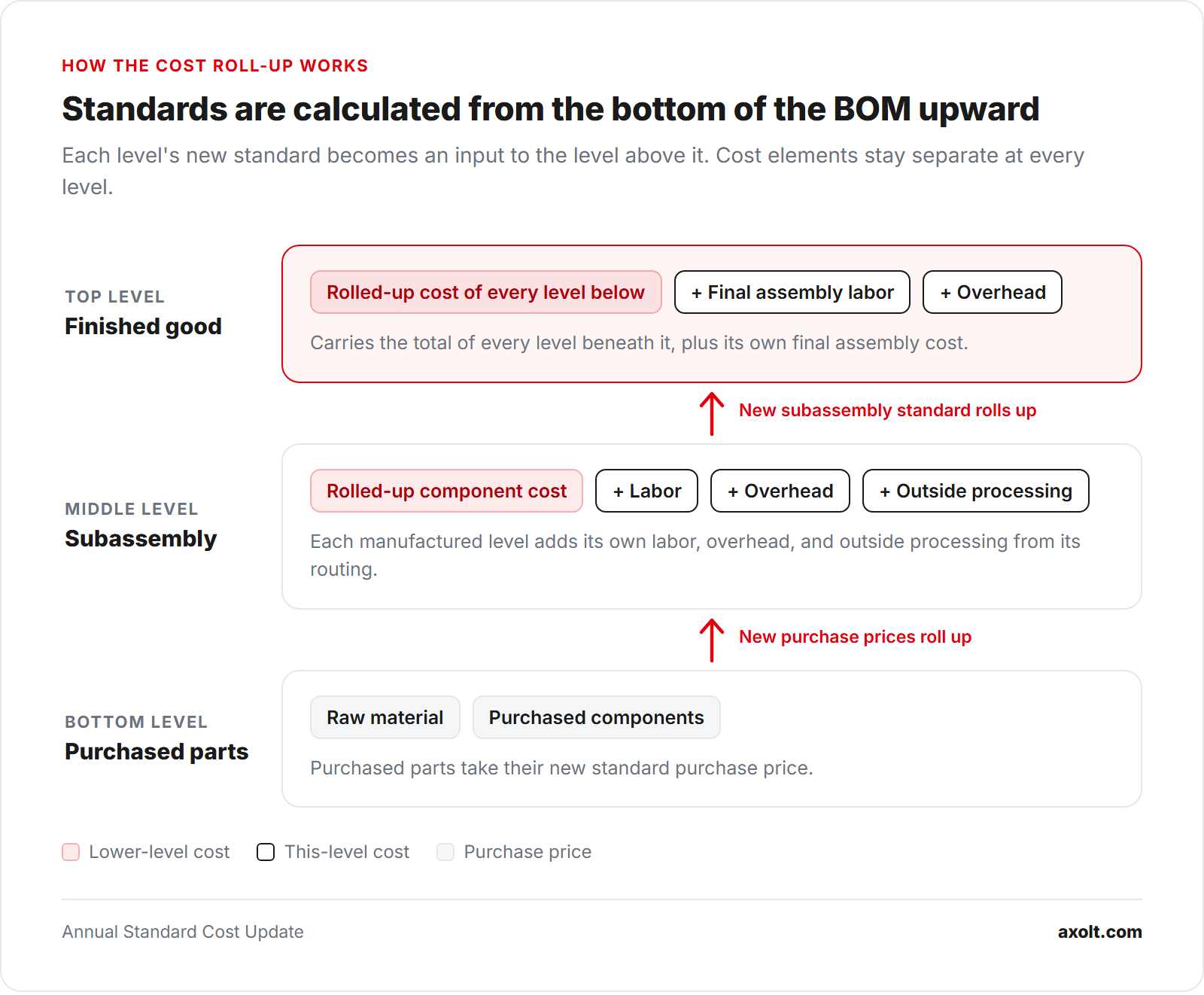
Most manufactured products have multi-level bills of materials: purchased parts go into subassemblies, and subassemblies go into finished goods. A cost roll-up calculates new standards from the bottom of the structure upward, so each subassembly's new standard becomes an input to the level above it.
- Purchased parts take their new standard purchase price.
- Each manufactured level adds its own labor, overhead, and outside processing from its routing to the rolled-up cost of its components.
- The finished good carries the total of every level beneath it, plus its own final assembly cost.
Keep the cost elements separate at every level, and distinguish this-level cost from lower-level cost. When a finished good's standard moves, you can then see whether the change came from a component price, a labor rate, or an overhead rate, instead of a single number that went up.
A Worked Example: Rolling Up a Pump Assembly
A pump manufacturer updates the standard for its PA-200 pump assembly. For the new year, steel prices are up 8%, the labor rate rises from $34 to $36 an hour, a process improvement cuts run time from 2.5 to 2.4 hours, and a new machining line raises normal capacity, which lowers the overhead rate from $52 to $50 per machine hour.
Material includes the rolled-up cost of the machined housing and purchased components. Labor and overhead are this-level and lower-level costs combined.
What the Example Shows
The total standard moved only 2.4%, but the cost elements moved in different directions. Material rose 6.8%, and a lower overhead rate hid most of it. A review that only compared total standards would have approved the pump without noticing that its material cost had jumped.
The overhead reduction also rests on an assumption: that the new line will run at the higher volume. If volume falls short, next year's overhead will be under-absorbed, and the gap will appear as an unfavorable overhead variance. Document the assumption so the variance can be explained when it appears.
A standard is a forecast you agree to measure against. Build it on realistic inputs, document why it changed, and freeze it.
Revaluing Inventory When Standards Change
When new standards take effect, inventory on hand is still carried at the old ones. It has to be restated, so that issues and shipments in the new year relieve inventory at the same cost it is carried at. The revaluation for each item is the quantity on hand multiplied by the difference between the new and old standard, across raw materials, work in process, and finished goods.
For the 1,200 PA-200 pumps in finished goods, that is 1,200 × $8.50, or a $10,200 increase. The steel and housings held in raw materials and work in process are revalued the same way.
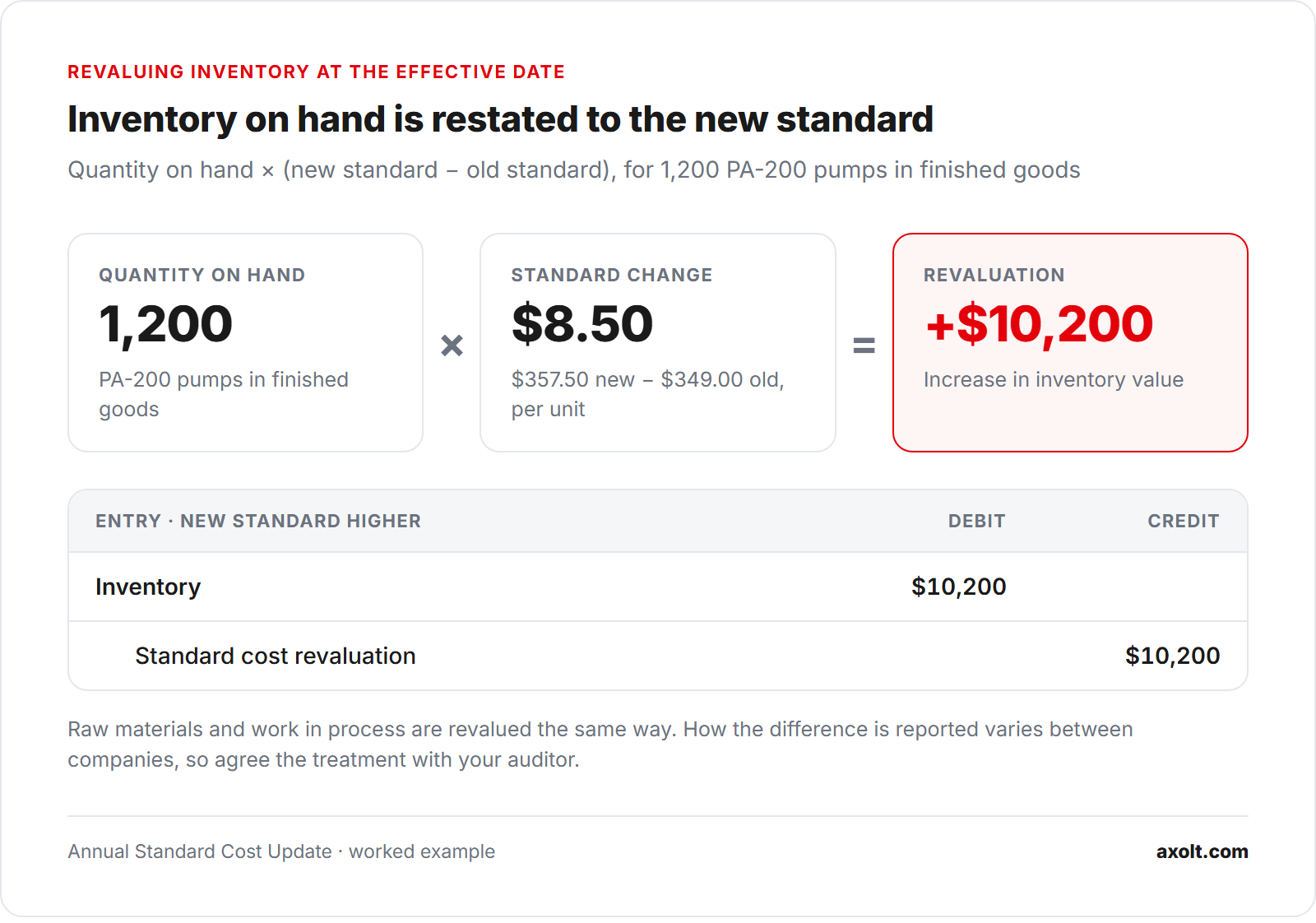
The treatment of revaluation differences varies between companies. Agree it with your auditor, especially when standards rise, because inventory must still approximate actual cost.
Timing matters. Most manufacturers run the revaluation as the first transaction of the new year, so the closing balance sheet stays on the standards the auditors tested and the new year starts on the new ones. Close as many work orders as possible before the cutover; mixing old-standard material issues with new-standard completions creates variances that say nothing about performance. Our guide to WIP accounting for manufacturers explains how those costs flow.
Revaluation does not replace the lower of cost and net realizable value test. If a higher standard pushes an item's carrying value above what it can be sold for, it still needs a write-down, as explained in our guide to excess and obsolete inventory.
What Changes in Next Year's Variances
New standards reset the baseline, and the first month of the new year is the test. A large variance in January may mean the standard is wrong, not that production is:
- Review the first month's variances by item and cost element, not just in total.
- Check overhead absorption against the volume assumption behind the new rate.
- Correct any standard set on a wrong assumption, with an effective date, a reason, and an approval.
- Track variance trends in every month-end close, so drift is caught long before next year's update.
Common Standard Cost Update Mistakes
- Using the last invoice price. A single purchase, especially a rush order or spot buy, is a poor guide to what you will pay next year.
- Building on a BOM that is about to change. If an engineering change is released in February, standards built on the old structure will be wrong for most of the year.
- Updating prices but not yields or run times. Price changes are visible; process changes are not. Both belong in the update.
- Setting overhead on volume you have never reached. An optimistic volume lowers the rate and flatters margins, then returns as an unfavorable variance.
- Changing standards mid-year without control. Every change needs an effective date, a reason, and an approval, or variances stop being comparable from month to month.
- Revaluing late, or not at all. If new standards relieve inventory still carried at the old ones, the difference builds up in the balance sheet and has to be found later.
- Approving without a comparison. Thousands of standards change at once. Review the largest changes by item and cost element before you sign off.
A Standard Cost Update Timeline
Adjust the timing to your fiscal calendar and the number of items you cost. If your year ends in December and you have not started, compress the early steps rather than skipping them.
- Ten weeks before year endAgree the effective date, scope, owners, and approval route.
- Eight weeks beforeFreeze BOM and routing versions, and list the engineering changes due early next year.
- Six weeks beforeCollect purchase prices, labor rates, the overhead budget, and normal capacity.
- Four weeks beforeRun the cost roll-up as a pending version, and compare it with current standards.
- Two weeks beforeReview the largest changes by item and cost element, then approve and freeze.
- First day of the new yearActivate the new standards and post the inventory revaluation.
- End of the first monthReview variances by cost element, and correct any standard built on a wrong assumption.
How an ERP Should Support the Update
Most of the effort in a standard cost update goes into collecting inputs and checking results, not into the arithmetic. An ERP should make both easier:
- Bills of materials and routings are versioned, so standards are built on a known, frozen basis
- New standards can be calculated and reviewed before they become active
- Roll-ups keep material, labor, overhead, and outside processing visible at every BOM level
- Revaluation is calculated by item and location and posted as one controlled transaction
- Production and inventory transactions reach finance as they happen, so variances show up the same day
Axolt runs manufacturing, inventory, and finance on one data model inside Salesforce. It supports multi-level bills of materials and routings with version control, so teams work from the latest definitions, and it tracks materials, labor, routing, work centers, production activity, and inventory movements in one system. Because stock movements and valuations reflect real-time activity, finance sees production cost and inventory value as transactions happen, not weeks after shipping.
Frequently Asked Questions
What is a standard cost?
A predetermined cost per unit for material, labor, overhead, and outside processing, based on expected prices, quantities, and normal capacity. Manufacturers use it to value inventory and to measure variances between expected and actual production costs.
How often should standard costs be updated?
Most manufacturers update all standards once a year, effective at the start of the fiscal year, and make event-driven updates in between when a major input such as a material price, BOM, or routing changes significantly. Keep the effective date and reason for every change.
What is a cost roll-up?
The calculation that builds the standard cost of a manufactured item from its bill of materials and routing, level by level, starting with purchased parts and adding labor, overhead, and outside processing at each manufactured level.
What happens to inventory when standard costs change?
Inventory on hand is revalued to the new standard: the quantity on hand multiplied by the difference between the new and old standard, with the offset recorded in a revaluation account. Most companies post it as the first transaction of the new year.
Should standards use current prices or expected prices?
Expected prices for the coming year, based on contracts, quotes, and purchasing forecasts, with the basis documented. IAS 2 expects standards to reflect normal levels of materials, labor, efficiency, and capacity utilization, which rules out one-off prices and best-case assumptions.
Start the Year on Standards You Can Trust
Axolt connects BOMs, routings, production, inventory, and finance on Salesforce, so production cost and inventory value come from the same records your teams use every day.
Book a Demo